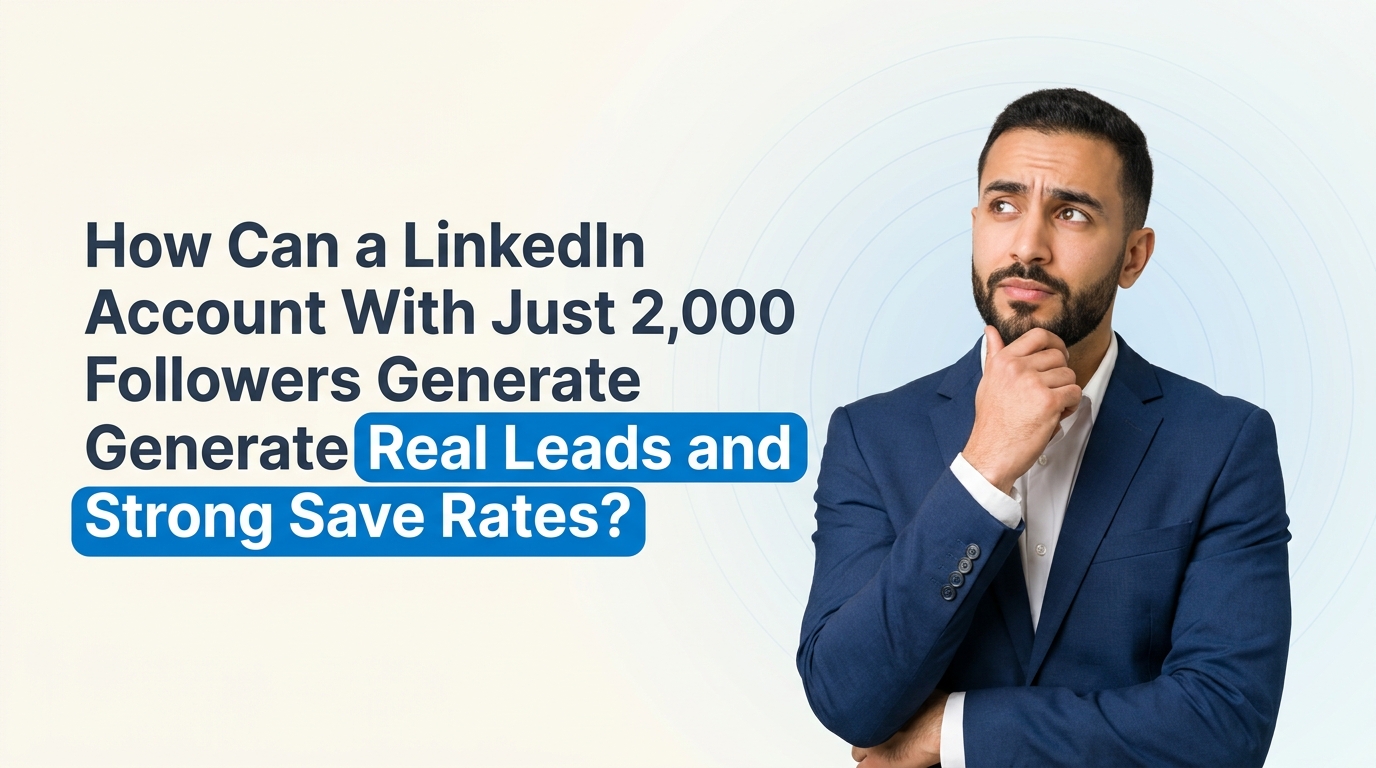
How Can a LinkedIn Account With Just 2,000 Followers Generate Real Leads and Strong Save Rates?
Discover how a LinkedIn account with just 2,000 followers can generate real leads. Learn strategies to boost save rates and engagement today!
If you saw a post from someone saying they helped CXOs grow on LinkedIn, built impressive save rates, increased impressions, and even generated leads from an account with only around 2,000 followers, your first thought might be: Is that actually realistic? Short answer: yes, it is.
And honestly, this is one of the biggest misunderstandings people still have about LinkedIn. A lot of brands, founders, consultants, and marketing teams assume they need a huge audience before they can get meaningful results. But on LinkedIn, relevance usually beats raw follower count.
So if you're wondering how a relatively small account can still drive leads, saves, reach, and conversations, let’s break it down in a simple way.
First, why do save rates matter so much on LinkedIn?
Likes are easy. Comments are visible. Shares feel impressive. But saves are different.
When someone saves a post, they’re basically saying: “This is useful enough to come back to.” That’s a strong quality signal. It often means the content did one or more of these things:
- Solved a practical problem
- Explained something clearly
- Included a framework people wanted to reuse
- Spoke directly to a job-related pain point
- Contained numbers, examples, or steps worth revisiting
On a platform like LinkedIn, that kind of engagement is often more valuable than vanity metrics. A post with modest likes but a high number of saves can quietly outperform louder content over time because it signals depth and usefulness.
If you want more context on how LinkedIn thinks about meaningful content and professional relevance, LinkedIn’s own marketing resources are worth browsing: LinkedIn Marketing Blog.
Can a small LinkedIn account really generate leads?
Yes, especially if the audience is specific.
This is the part people miss: 2,000 random followers and 2,000 relevant followers are not the same thing.
If an account is followed by decision-makers, operators, founders, recruiters, or niche professionals who actually care about the topic being posted, then even a smaller audience can create real business outcomes. In some cases, a focused audience performs better than a large but loosely connected one.
Ask yourself:
- Are the followers the right people?
- Does the content speak to their day-to-day challenges?
- Is the profile positioned clearly enough to convert interest into inquiry?
- Are posts leading naturally into conversations, DMs, profile visits, or calls?
If the answer is yes, then leads from 2,000 followers are not surprising at all.
What usually drives impressions on LinkedIn without a huge audience?
Impressions on LinkedIn are often driven by a mix of content quality, engagement patterns, audience fit, and consistency. You do not need celebrity-level reach. You need posts that give people a reason to stop and interact.
Here are a few common reasons smaller accounts can still get strong impressions:
- Strong hooks: The opening line creates curiosity or addresses a direct pain point.
- Clear formatting: Short paragraphs make posts easier to read on mobile.
- Useful insights: Readers feel like they learned something in under a minute.
- Relevant niche positioning: The algorithm has a better idea of who to show the content to.
- Thoughtful comments: Early engagement from the right people helps extend reach.
- Consistency: Repeated signals help LinkedIn understand the account’s topic authority.
For a deeper look at content strategy and thought leadership, HubSpot has helpful reading here: HubSpot’s LinkedIn Marketing Guide.
What kind of content tends to get saves and leads at the same time?
This is where strategy matters. Not all content that gets attention gets business results. And not all content that converts gets shared widely. The best-performing LinkedIn content often sits in the middle: valuable enough to save, practical enough to act on.
Some formats that often work well include:
- Step-by-step posts: “How we did X in 30 days”
- Breakdown posts: “Why this campaign worked”
- Mistake-based posts: “3 things hurting your LinkedIn reach”
- Framework posts: Easy structures readers can apply immediately
- Mini case studies: Specific examples with outcomes
- Opinion posts with proof: A point of view backed by actual results
The key is that the post should not stop at motivation. It should offer something concrete.
For example, saying “consistency matters” is fine. But saying “we posted 3 times a week, used founder-led storytelling, narrowed our audience to B2B SaaS operators, and optimized for saves instead of likes” is much more useful. That’s the sort of thing people save.
Why does growing a CXO profile look different from growing a company page?
This matters a lot. People connect with people faster than they connect with logos.
CXO and founder-led LinkedIn strategies often perform better because they feel more human, more immediate, and more trustworthy. Audiences usually respond to:
- Personal lessons from leadership
- Behind-the-scenes decision making
- Clear opinions on industry trends
- Stories with a business takeaway
- Practical advice based on lived experience
That doesn’t mean company pages have no value. They do. But if the goal is engagement and conversation, executive visibility often becomes the faster route.
This is also why many LinkedIn growth strategies today focus on personal brand plus business positioning, not just brand publishing alone.
What should someone focus on if they want similar results?
If you’re trying to replicate the kind of outcome described in that Reddit post, here’s a practical checklist:
- Define the audience clearly: Who exactly are you trying to reach?
- Choose 3 to 5 content pillars: Keep topics consistent enough to build recognition.
- Write for saves, not just likes: Teach, simplify, and give examples.
- Use real proof: Screenshots, numbers, outcomes, and lessons all help.
- Improve the profile: Your headline, about section, and featured links should support conversion.
- Start conversations: Comments and DMs matter as much as publishing.
- Measure the right metrics: Track profile visits, inbound messages, leads, and qualified engagement.
If you want a solid overview of how to improve your LinkedIn profile for credibility, this guide from LinkedIn can help: LinkedIn profile tips.
Is follower count overrated on LinkedIn?
In a lot of cases, yes.
Follower count can help with social proof, but it does not guarantee pipeline, trust, or qualified reach. A well-positioned account with a smaller but relevant network can outperform a larger one that lacks clarity.
What actually matters more?
- Audience fit
- Content clarity
- Positioning
- Trust signals
- Consistency over time
- Ability to turn attention into conversations
That’s why the “2,000 followers but real leads” outcome is believable. Not because small numbers are magically better, but because focused strategy usually outperforms broad noise.
So what’s the bigger takeaway from that Reddit post?
The post is interesting because it highlights something people in B2B marketing and personal branding are learning fast: LinkedIn growth is not only about becoming visible. It’s about becoming useful.
If content creates saves, starts relevant conversations, reaches the right people, and supports a strong profile, then leads can absolutely happen without a massive audience.
That’s the real lesson here. Not “go viral.” Not “post every day no matter what.” Just build content and positioning that make professional trust easier.
And honestly, if you’re sitting there wondering whether your account is “too small” to matter, it probably isn’t. With the right messaging and a clear strategy, a smaller LinkedIn presence can still do serious work.
Write better LinkedIn content with exeedin
exeedin is an AI tool that helps you ideate, draft, and schedule content for your LinkedIn. Turn raw ideas into polished posts and stay consistent without the guesswork. Try exeedin.