How Can You Scale LinkedIn Outreach Without Buying or Renting Profiles?
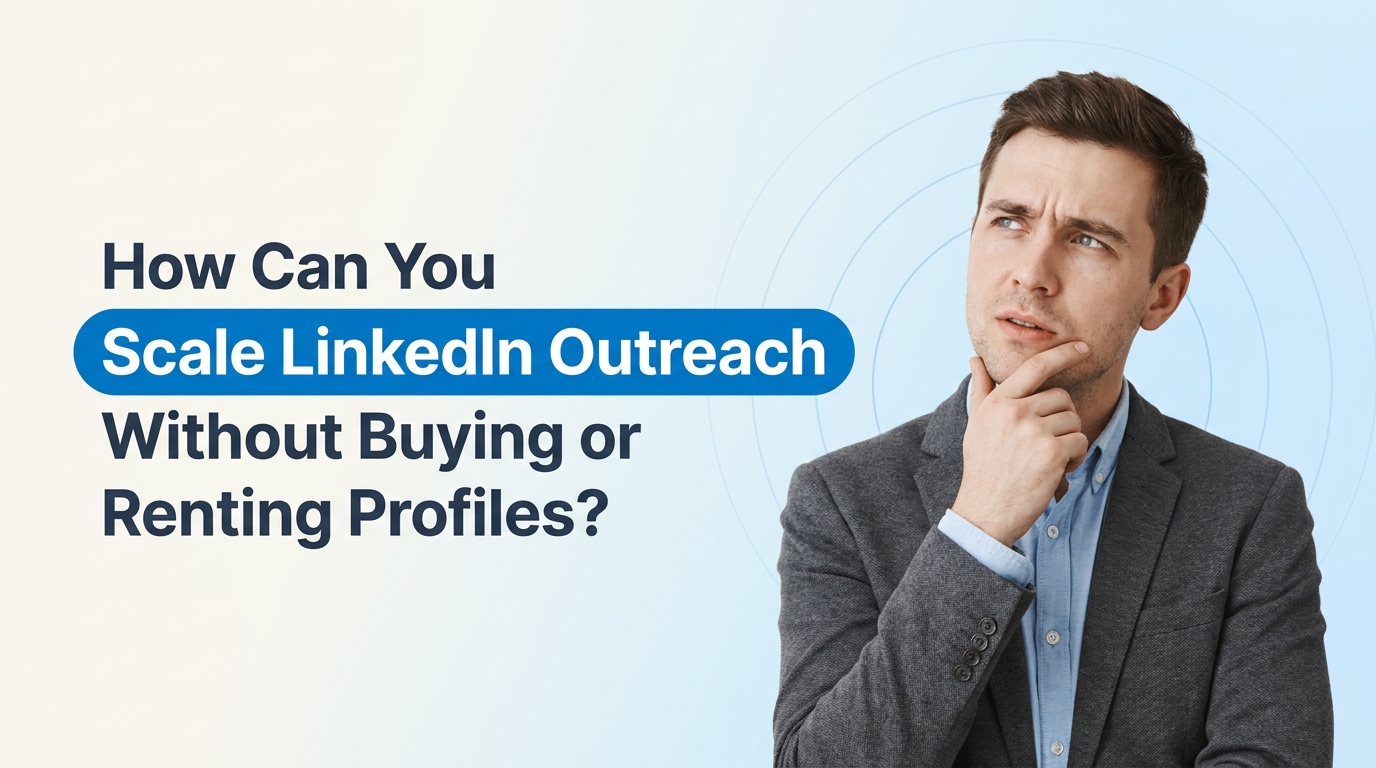
If you’re trying to run LinkedIn outreach with 25+ profiles, the biggest question usually isn’t just how to scale. It’s how to do it in a way that’s cost-effective, sustainable, and not likely to blow up your account quality later.
So if you’re wondering whether you should build profiles through your own network, rent them from providers, or find some cheaper shortcut, the honest answer is this: renting or sourcing profiles at scale is usually the wrong foundation. It might look efficient in the short term, but it often creates trust, compliance, and deliverability problems that make outreach harder over time.
A better question is: what’s the safest and most effective way to scale LinkedIn outreach without depending on rented or questionable profiles? That’s where this gets practical.
Why renting LinkedIn profiles is risky
A lot of teams hit a wall and think, “Maybe we just need more accounts.” That sounds simple, but LinkedIn is built around real identities and real relationships. When outreach starts relying on rented accounts, low-quality profiles, or loosely controlled identities, a few problems tend to show up fast:
- Trust drops: people can tell when a profile feels generic, incomplete, or disconnected from a real professional story.
- Account restrictions become more likely: unusual behavior patterns, shared access, and low authenticity can trigger limits.
- Reply quality gets worse: even if connection requests are accepted, conversations often stall because the profile behind the message doesn’t feel credible.
- Brand risk increases: if you’re reaching out on behalf of a company, low-trust profiles can hurt more than they help.
If you haven’t reviewed LinkedIn’s own guidance around authenticity and professional conduct in a while, it’s worth checking their official policy pages and help center: LinkedIn Help.
So what should you do instead?
If your goal is scale, you don’t necessarily need more random profiles. You need a better outreach system. In most cases, that means building a structure around real people, clear segmentation, and responsible volume.
Here are the most cost-effective options that actually hold up.
1) Use real employee or founder profiles first
This is usually the strongest place to start. If you already have internal team members, sales reps, recruiters, founders, or account managers with legitimate LinkedIn profiles, those accounts are often far more valuable than rented profiles.
Why? Because real profiles come with:
- existing network history
- authentic career timelines
- more credible engagement
- better reply rates
Instead of asking, “How do I get 25 profiles?” ask:
- Who on the team already has a credible LinkedIn presence?
- Which profiles are actually relevant to the audience we want to contact?
- Can we improve profile positioning before increasing message volume?
Sometimes 5 strong profiles outperform 25 weak ones. That’s not just a nice idea. It’s usually what happens in practice.
2) Improve profile quality before scaling activity
A profile used for outreach should not look like it was set up only to send messages. Before scaling, tighten the basics:
- Professional photo that looks natural
- Clear headline that explains role and value
- About section that sounds human, not stuffed with buzzwords
- Relevant experience and company details
- Some organic activity like posts, comments, or reactions
If someone clicks your profile after receiving an outreach message, that page needs to answer a simple question: “Is this a real person worth replying to?”
For profile optimization tips, LinkedIn’s own best practices and professional branding resources are a good starting point, and this HubSpot article also gives a useful breakdown: HubSpot: LinkedIn Profile Tips.
3) Segment your outreach instead of multiplying accounts
Sometimes teams think they need more profiles when the real issue is poor targeting. If one account is trying to reach every industry, every region, and every buyer type, performance drops. The answer isn’t always more accounts. Sometimes it’s better segmentation.
Try breaking outreach down like this:
- By persona: founder to founder, recruiter to candidate, sales lead to buyer
- By industry: SaaS, healthcare, finance, e-commerce
- By geography: region-specific messaging and timing
- By offer: demo outreach, partnership outreach, hiring outreach, event outreach
This makes each profile’s activity feel more natural and improves response quality without forcing you to hunt for rented accounts.
4) Use LinkedIn Sales Navigator if prospecting is the bottleneck
If sourcing is the hard part, Sales Navigator is usually more useful than trying to buy profile capacity. It helps with advanced search, account lists, lead lists, and better targeting filters.
That matters because a lot of “scale problems” are really “bad lead list problems.” If your targeting is cleaner, you often need fewer profiles and fewer messages to get the same result.
You can learn more here: LinkedIn Sales Navigator.
5) Warm up activity like a real human would
This part gets ignored a lot. Outreach works better when the account sending messages also behaves like a normal LinkedIn user. That means:
- connecting gradually, not all at once
- commenting on relevant posts
- sharing occasional insights
- replying to inbound messages normally
- keeping daily activity within a realistic range
If an account only sends invites and cold messages, it looks thin. If it also engages with the platform like a professional, it becomes more believable and usually performs better.
6) Build a simple outreach workflow that your team can manage
Cost efficiency is not just about account cost. It’s about operational cost too. If 25 profiles create chaos, missed follow-ups, and duplicated messaging, that system isn’t cheap. It’s messy.
A better workflow usually includes:
- Clear ownership for each profile
- Defined ICPs for each outreach lane
- Message templates that are personalized, not robotic
- CRM or tracking sheet for follow-ups and status
- Weekly review of acceptance rate, reply rate, and booked conversations
If you want a simple framework for cold outreach messaging, this video can help with tone and structure: YouTube: LinkedIn Outreach Tips.
What’s the most cost-effective path in real terms?
If we strip this down, the most cost-effective approach usually looks like this:
- Use real internal profiles wherever possible
- Optimize those profiles before scaling
- Use better targeting tools instead of more questionable accounts
- Segment outreach so each profile has a clear role
- Track performance and double down on what gets replies
That’s not the fastest-sounding answer, but it’s the one that tends to last. Renting profiles can look cheaper upfront, but once you factor in poor trust, weaker replies, platform risk, and brand damage, it often becomes more expensive than just building a clean system from the start.
Questions worth asking before you scale further
- Do we actually need more profiles, or do we need better targeting?
- Are our current profiles credible enough to convert replies?
- Is our offer clear and relevant to the people we’re contacting?
- Are we measuring acceptance and reply rates by profile?
- Would 5 to 10 strong profiles outperform 25 low-trust ones?
Those questions usually lead to better decisions than just trying to source more accounts at the lowest possible rate.
Final thought
If you’re serious about LinkedIn outreach, think less about “how do I get profiles at scale?” and more about how do I build a scalable LinkedIn motion around real credibility? That shift matters. It protects your brand, improves reply quality, and usually saves money over time.
Write better LinkedIn content with exeedin
exeedin is an AI tool that helps you ideate, draft, and schedule content for your LinkedIn. Turn raw ideas into polished posts and stay consistent without the guesswork. Try exeedin.