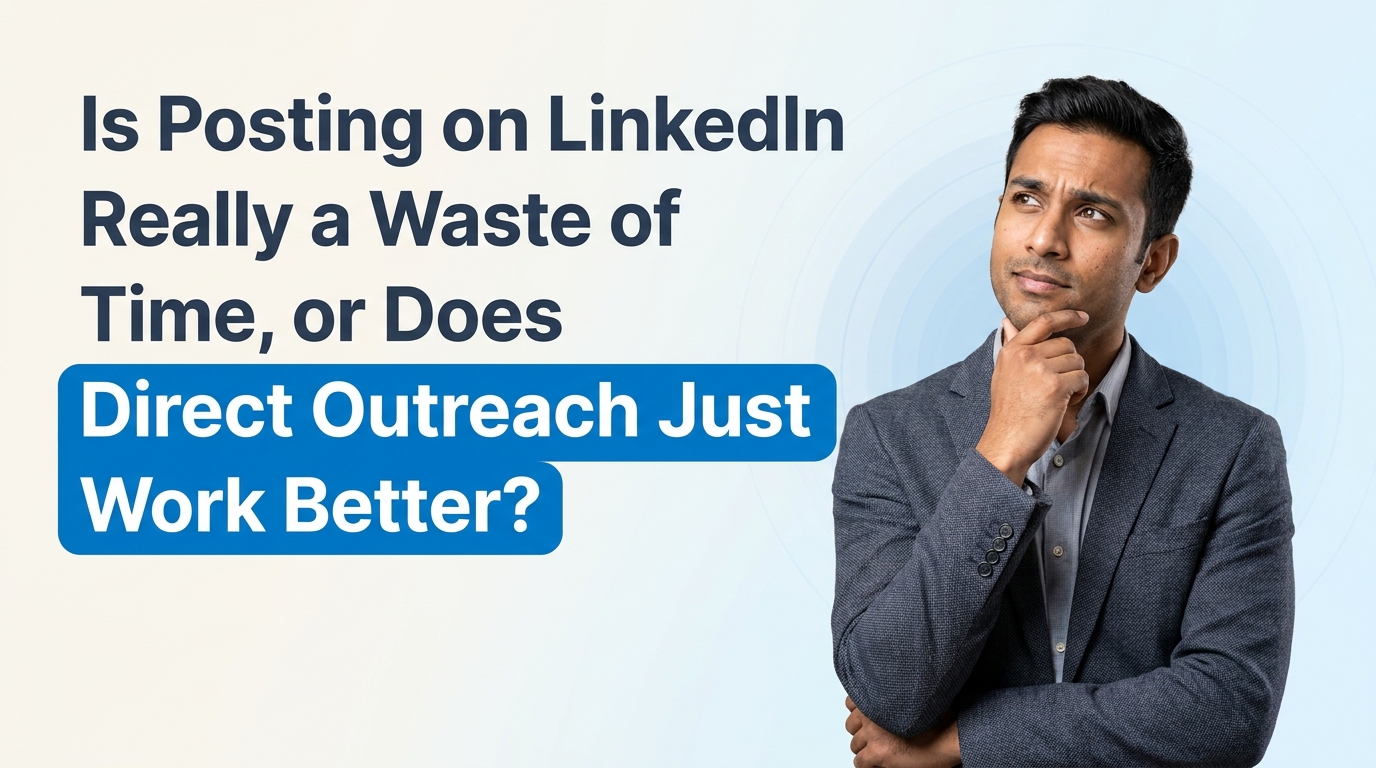
Is Posting on LinkedIn Really a Waste of Time, or Does Direct Outreach Just Work Better?
Explore if posting on LinkedIn is effective or if direct outreach is the better strategy. Read more to find out how to maximize your LinkedIn efforts.
If you have spent years on LinkedIn and noticed that direct outreach brings clients while posting brings mostly impressions, likes, or silence, you are definitely not the only one. A lot of people quietly come to the same conclusion: content may build visibility, but conversations close deals.
The Reddit post raises a fair question: was the posting strategy wrong, or is LinkedIn simply more useful as a direct relationship platform than a content platform? The honest answer is that both can be true at the same time.
For many founders, consultants, agency owners, recruiters, and B2B service providers, direct outreach is often the clearest path to revenue. But that does not automatically mean posting is useless. Usually, it means posting has a different job. It supports trust. Outreach creates motion. And when the two work together, LinkedIn becomes a lot more effective.
Why direct outreach often feels like gold
Let’s start with the part that makes total sense. Direct outreach works because it is intentional. You are not waiting for the algorithm to decide whether your post deserves reach. You are choosing who to talk to.
That matters because LinkedIn, at its core, is still a professional network. People log in to hire, research, recruit, sell, partner, and learn. So when someone sends a thoughtful message to a relevant prospect, it can feel much more practical than posting into the void.
Here’s why outreach often outperforms posting for lead generation:
You control the target. You can focus on decision-makers instead of hoping the right person sees your content.
You shorten the path to conversation. A message can lead to a reply faster than a post leads to a meaningful inbound lead.
You can personalize. Good outreach speaks to a person’s role, business, or situation.
You can measure it more clearly. Replies, booked calls, and conversion rates are easier to track than vague engagement.
This is also backed by how LinkedIn itself positions social selling. Their own resources regularly point to relationship-building and relevant outreach as a major part of success on the platform. You can read more on LinkedIn’s official sales resources here: https://business.linkedin.com/sales-solutions.
Is your profile ready for buyers who check you out?
Paste your profile link and see your score right away, with clear fixes for your headline, About section and experience. No account needed.
Or open the LinkedIn profile evaluator
So, is posting actually a waste of time?
Usually, no. But it can feel like a waste of time when the expectation is wrong.
If you expect every post to generate clients directly, you’ll probably be disappointed. That is not how LinkedIn content works for most people. Posting often plays more of a trust and positioning role than a direct sales role.
Think about what happens when you reach out to someone and they check your profile. What do they see?
Do they understand what you do in a few seconds?
Do they see proof that you know your field?
Do your posts show relevance, consistency, and credibility?
Does your company page look active enough to feel real?
This is where posting still matters. Even if posts do not bring clients directly, they often help convert warm prospects who are already evaluating you. In that sense, the Reddit post actually hints at something important: keeping the company profile fresh for warm prospects is not small. That is part of the sales process.
HubSpot has a helpful breakdown on lead generation and content strategy that connects well to this idea: https://blog.hubspot.com/marketing/lead-generation.
What if posting was not wrong, just incomplete?
Sometimes people post consistently for months and see very little business impact. That does not always mean the content was “bad.” It may mean the content was disconnected from the rest of the funnel.
A few useful questions to ask:
Were you posting for peers instead of buyers?
Did your posts educate, or just state opinions?
Was there any clear next step for readers?
Did your profile support the message your content was sending?
Were you using content to start conversations, or treating content as the entire strategy?
That last point matters a lot. The people who get the most out of LinkedIn usually do not choose between posting and outreach. They use content to make outreach warmer. Then they use outreach to turn attention into actual business conversations.
A more realistic way to think about LinkedIn
Here’s a simpler framework:
Posts build familiarity.
Your profile builds trust.
Direct outreach starts conversations.
Follow-up creates opportunities.
When any one of these is missing, LinkedIn feels less effective than it should.
So if you are saying, “I get 100% of my clients from outreach, not posts,” that may be true. But it is still worth asking: did the posts help those prospects feel more confident once they looked you up? In many cases, yes. They may not have created the opportunity, but they supported the decision.
When posting makes sense, and when it doesn’t
Not every business should invest equally in content. That is another honest part of the conversation.
Posting tends to make more sense when:
You have a longer sales cycle and prospects research before replying
You sell expertise, strategy, or advisory services
You want to build authority in a niche
You need social proof for inbound opportunities
You have enough insights to share consistently
Posting may be lower priority when:
You already have a proven outbound system that converts
Your audience is highly specific and reachable directly
You do not have time to create strong content consistently
You are treating posting as busywork rather than strategy
That does not mean ignore content completely. It just means use content with a purpose, not because everyone says you should post daily.
If direct outreach is working, how do you make it even better?
If outreach is already your best channel, the goal is not to abandon it. The goal is to support it better.
Here are a few practical ways to do that:
Improve your profile headline and about section. Make it easy for someone to understand who you help and what problem you solve.
Keep a few high-quality posts live on your profile. These can answer common objections, explain your process, or share relevant case examples.
Send fewer, better messages. Generic outreach usually fails. Clear, relevant, respectful outreach performs better.
Follow up like a person. Not every follow-up needs to be a pitch. Sometimes a thoughtful check-in works better.
Use company pages as validation, not the core engine. A fresh company page can help confirm legitimacy.
If you want a deeper look at social selling best practices, Hootsuite has a solid guide here: https://blog.hootsuite.com/social-selling/.
And for people who prefer video, this YouTube channel often shares useful LinkedIn sales and content advice: https://www.youtube.com/@LinkedIn.
The balanced answer to the Reddit post
So, did you post the wrong way? Maybe. But maybe that is not the real issue.
A better answer is this: LinkedIn posting is not automatically a waste of time, but it is often overrated as a direct lead source. For many people, especially in B2B, direct outreach is where the actual client conversations begin. Posting is often there to support credibility, authority, and conversion once interest already exists.
That means the Reddit post is not wrong. It is just incomplete. Outreach may be the gold, but content can still be the proof that helps someone trust the person reaching out.
Final thought
If LinkedIn feels more useful as a relationship platform than a publishing platform for your business, that is valid. You do not need to force a content-heavy strategy just because it is popular. But it is worth making sure your profile, company page, and a small body of useful content are doing their part when prospects come looking.