Why Are LinkedIn Carousel Posts Suddenly Getting Fewer Impressions?
LinkedIn may be rebalancing how it ranks formats, and content fatigue or timing can add to it. See what to check if carousel reach dropped 6 to 10 times.
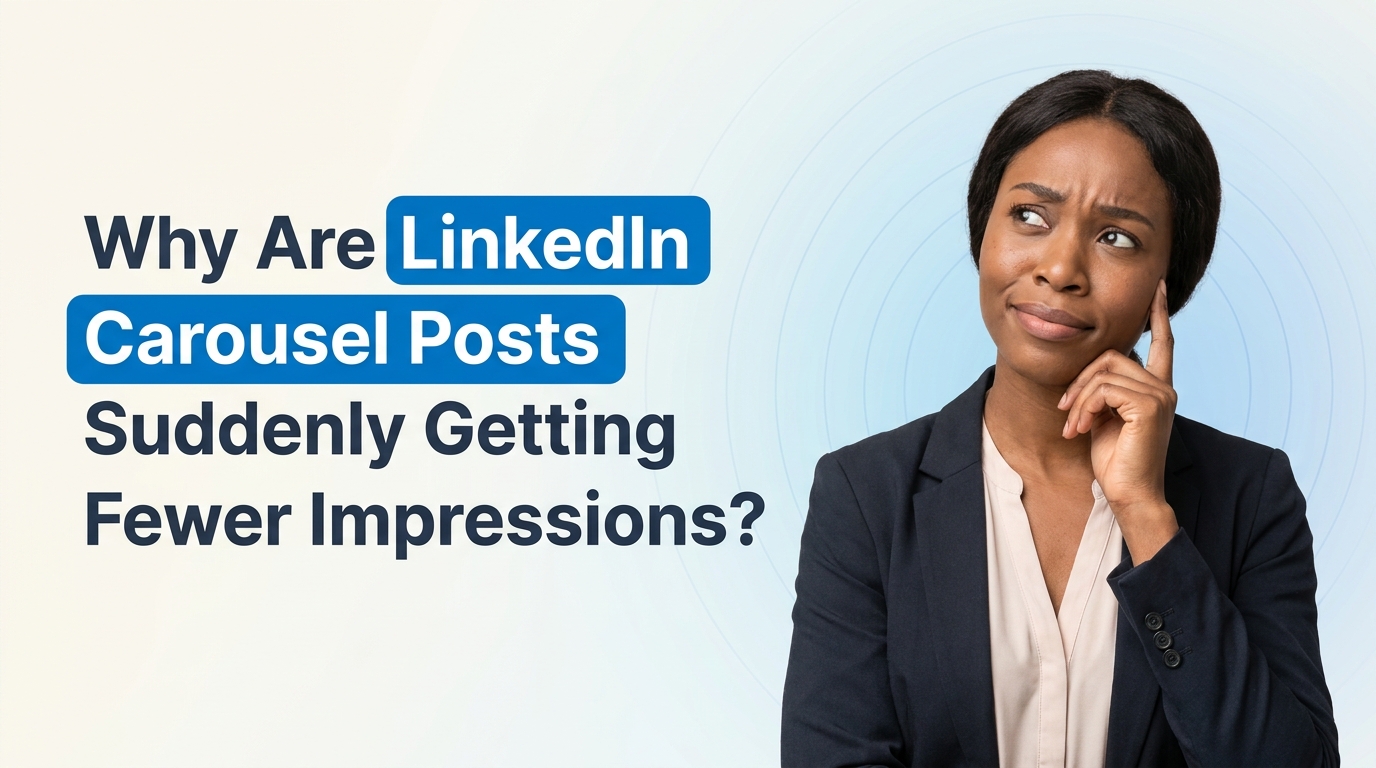
If your LinkedIn carousel posts have dropped from decent reach to almost nothing, you are definitely not the only one noticing it. A lot of marketers, founders, in-house social teams, and freelancers have been asking the same question lately: why are carousel posts suddenly underperforming even when nothing obvious has changed?
The short answer is this: it may not be just you. LinkedIn distribution shifts happen more often than most people realize, and small platform changes can have a big impact on a format like carousels. At the same time, it is also possible that audience behavior, content fatigue, post structure, or engagement timing is affecting results more than before.
So if you are seeing 6 to 10 times fewer impressions on carousel posts, here is a practical breakdown of what might be going on and what you can actually do next.
First, yes, LinkedIn post performance can change fast
One of the frustrating things about LinkedIn is that performance is not always stable, even when your creative quality stays consistent. The platform does not publicly explain every ranking tweak in detail, but it is well known that feed visibility changes over time.
That means a post type that worked really well last month can suddenly cool off. Then a few weeks later, another format starts getting better distribution.
So the first question to ask is:
- Is this a content problem?
- Is this a format problem?
- Or is this a distribution problem caused by LinkedIn itself?
Usually, the answer is some mix of all three.
Get 10 hooks for your next post
Type what your post is about and get 10 opening lines from different proven angles. Free, no signup.
Or open the free LinkedIn hook generator
Why carousel performance may be dropping
1. LinkedIn may be rebalancing how it ranks formats
Platforms regularly test how much reach they give to specific content types. If carousels were getting strong results for a while, LinkedIn may now be distributing them more selectively to improve overall feed quality or to give more visibility to other formats like text posts, videos, thought-leadership posts, or comments-driven content.
This is not unusual. Social platforms often reduce the reach advantage of a format after it becomes heavily used.
Helpful reading from LinkedIn on best practices and content strategy can be found here: LinkedIn Marketing Blog.
2. Audience fatigue is real
Even if your clients are posting the same quality as before, the audience may simply be reacting differently. A carousel that once felt useful can start feeling predictable if too many creators in the same niche are using similar hooks, design styles, and slide structures.
Ask yourself:
- Are the first two slides still sharp enough to stop the scroll?
- Are the carousels teaching something truly specific?
- Do they feel original, or just polished?
- Have competitors started posting similar content more often?
People usually do not get tired of value. They get tired of repetition.
3. The hook matters more than the design
Many carousel posts look good but do not create enough curiosity or urgency. If impressions are dropping, one possibility is that the content is not generating strong enough early engagement signals.
On LinkedIn, the early reaction window matters a lot. If the platform shows your post to a test audience and they do not pause, click, react, or comment, reach can slow down quickly.
That means your opening needs to do more than look nice. It should answer one of these questions immediately:
- Why should I care?
- What problem does this solve?
- What will I learn if I keep going?
- Why is this relevant right now?
4. Caption structure may be hurting distribution
Sometimes teams focus so much on the PDF or document slides that the caption becomes an afterthought. But on LinkedIn, the caption still plays a major role in context, click intent, and conversation.
If the caption is too generic, too long without a strong opening, or too promotional, that can limit momentum.
A stronger caption usually includes:
- A clear first line
- A relatable problem
- A useful takeaway or opinion
- A natural invitation to comment
Instead of asking for vague engagement like “Thoughts?”, try asking something more specific like: “Have you seen carousel reach dip recently, or are your document posts still stable?”
5. Broader engagement on the account may be weaker
Sometimes the issue is not the carousel itself. It may be the account’s overall activity and relevance signals. If the creator or brand page is posting consistently but not actively participating on the platform, LinkedIn may have less reason to amplify the content.
Things to review:
- Are they replying to comments quickly?
- Are they commenting on other relevant posts during the week?
- Is their network still growing?
- Are they posting only one format repeatedly?
LinkedIn tends to reward people who act like active participants, not just broadcasters.
How to diagnose the issue without guessing
If you want to know whether this is a temporary algorithm shift or a content-specific issue, test in a structured way for two to four weeks.
Here is a simple breakdown:
- Compare carousel posts against text-only posts posted to the same audience.
- Test different hooks on the first slide and in the caption.
- Reduce slide count if your carousels are long. Sometimes shorter performs better.
- Vary the topic angle even if the niche stays the same.
- Post at different times and compare early engagement.
- Track saves, comments, click-throughs, and profile visits, not just impressions.
This is important because low impressions do not always mean low value. In some cases, reach drops but lead quality stays strong. For B2B brands, that matters more.
For a broader look at what drives engagement on LinkedIn, Hootsuite has a useful guide here: How the LinkedIn Algorithm Works.
What to try if your carousel reach is down
Refresh the format, not just the design
Instead of making the same style of carousel again, test a different user experience:
- Contrarian takes
- Case study breakdowns
- Mistakes to avoid
- Before-and-after examples
- Shorter “micro-carousel” formats
- Data-led slides with one insight per page
Sometimes it is not that LinkedIn hates carousels. It is that the audience is responding better to a different type of story.
Improve the first slide dramatically
The first slide should be treated like a headline on a landing page. It needs clarity, not cleverness. Be specific. Promise something practical. Avoid vague statements that could apply to anything.
For example, a stronger opening might be:
- “Why our LinkedIn carousel impressions dropped 82% in 3 weeks”
- “3 reasons B2B carousels are getting less reach right now”
- “What changed when our usual LinkedIn document posts stopped performing”
Use comments as part of the strategy
One of the best ways to support distribution is to create genuine discussion. Not fake engagement bait, just real conversation. Ask something people can answer from experience. Then respond thoughtfully.
The more relevant the conversation, the more likely the post continues circulating.
Mix formats intentionally
If carousels are underperforming, do not panic and abandon them completely. But also do not rely on them alone. A healthier content mix usually includes:
- Text-only opinion posts
- Carousels or document posts
- Short native videos
- Founder-led observations
- Client or campaign lessons
- Comment-led visibility strategies
This gives you better data and protects your reach from format-specific volatility.
If you want a helpful video on LinkedIn content strategy trends, this YouTube resource may be worth reviewing: LinkedIn Content Strategy Videos on YouTube.
So, is it the algorithm or not?
Most likely, yes, partially. It is very possible that LinkedIn has adjusted distribution patterns around carousel or document-style posts. But it is rarely just the algorithm by itself.
Usually the real answer is:
- The platform shifted
- The audience got pickier
- The format became more saturated
- Early engagement signals became harder to win
That does not mean carousel posts are dead. It just means they probably need more thoughtful positioning than they did before.
Final thought
If you are seeing a massive drop in LinkedIn carousel performance lately, your experience sounds very believable. It is not automatically a sign that your content quality suddenly got worse. More often, it is a sign that the environment changed and your strategy now needs a refresh.
The best next move is to test calmly, compare formats, tighten your hooks, and look beyond impressions alone. A few weeks of clean testing will tell you far more than guessing ever will.
And if this is something your team is dealing with across multiple client accounts, this is exactly the kind of issue that benefits from outside perspective. At EXEED Digitals, we regularly help brands make sense of LinkedIn performance drops, content format shifts, and engagement plateaus. Our team supports businesses with strategy, content direction, and LinkedIn growth decisions that are based on actual performance patterns, not random assumptions. You can learn more here: EXEED Digitals Services. We have helped 100s of brands on LinkedIn, and this kind of carousel performance concern is exactly where practical support can make the difference.
en