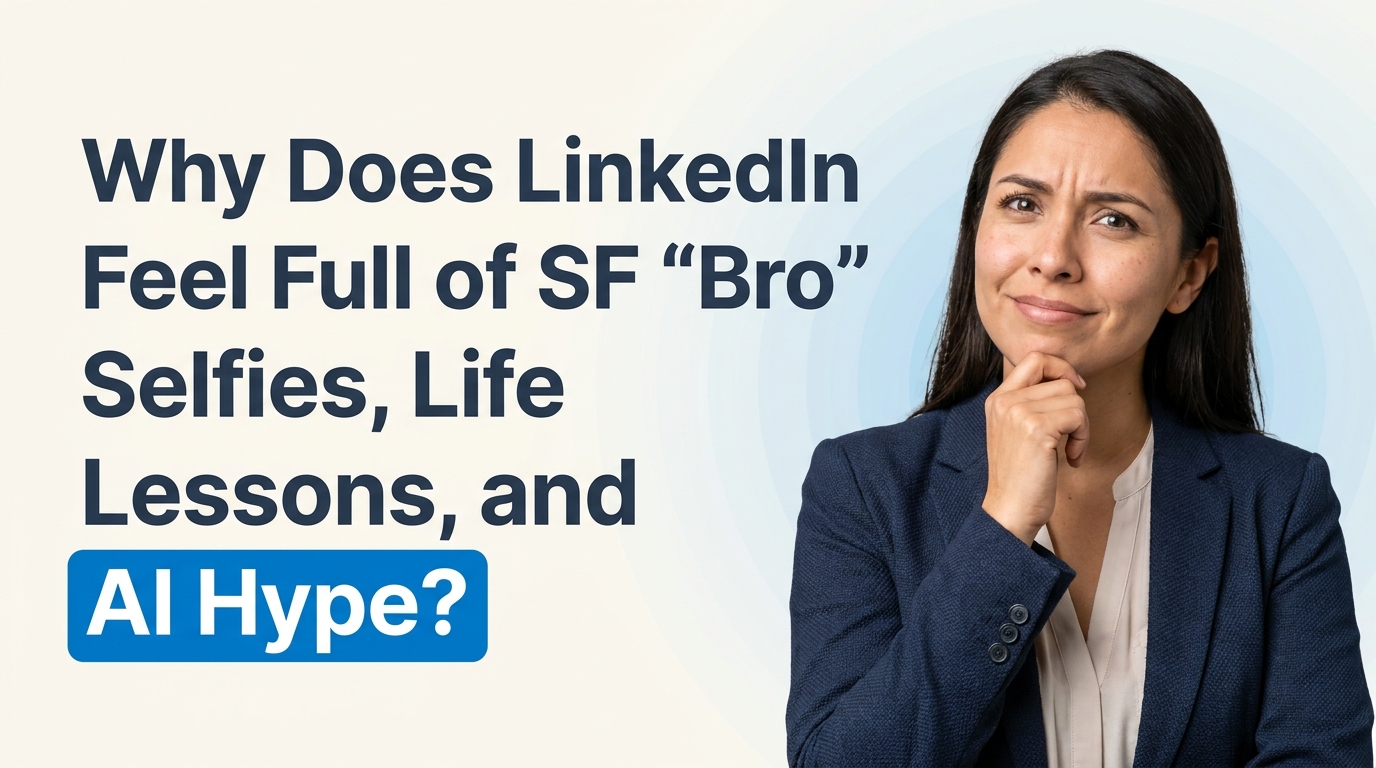
Why Does LinkedIn Feel Full of SF “Bro” Selfies, Life Lessons, and AI Hype?
Because it works on the platform. Faces, personal stories and bold takes get quick engagement, so creators keep repeating them. See what drives it.
If LinkedIn has started feeling like a strange mix of resume advice, startup bragging, selfies, personal philosophy, wedding updates, and AI hot takes, you are not imagining it. A lot of people have the same reaction: Wasn’t LinkedIn supposed to be about jobs, internships, and professional networking?
That frustration is real, especially when your feed keeps serving the same kind of post over and over. You block one “thought leader,” and then another shows up with a nearly identical selfie and a five-line lesson about discipline, failure, or building in public. It can feel repetitive, performative, and honestly a little exhausting.
So what is actually going on here? Are these people genuinely impressive? Are they really as successful as they sound? And why does everything somehow lead back to AI startups?
Let’s break it down in a normal way.
First: why are there so many selfies and “life lesson” posts on LinkedIn?
The short answer is simple: because it works on the platform.
LinkedIn rewards content that gets attention quickly. Faces perform well. Personal stories perform well. Strong opinions perform well. Short “I learned this at 22” posts perform well. Whether people love that or hate it, the platform keeps surfacing what gets engagement.
That means a lot of creators and founders have learned a few patterns:
- A selfie makes the post feel more personal and stops people from scrolling.
- A life lesson gives the post a takeaway, even if it is obvious.
- A founder story creates status, or at least the appearance of status.
- A bold statement about AI, hustle, hiring, or success invites comments and shares.
So if you are wondering, “Why the selfies?” the answer usually is not that deep. It is often just attention strategy.
LinkedIn has gradually shifted from being only a digital resume site into a personal brand platform. That is why it sometimes feels closer to Instagram, X, or even creator-led YouTube than the older version of LinkedIn many people remember.
If you want a broader look at how the LinkedIn algorithm tends to reward engagement, LinkedIn’s own official guidance is a useful starting point: LinkedIn content best practices.
Readers check your profile after your post. Is it ready?
Paste your profile link and see your score right away, with clear fixes for your headline, About section and experience. No account needed.
Or open the LinkedIn profile evaluator
Does that mean these people are fake?
Not always. But it does mean you should read their content with some context.
Some of the people posting are genuinely smart, hardworking, and successful. Some have built real companies. Some have raised money. Some have strong networks and know how to market themselves early.
At the same time, LinkedIn naturally encourages image management. People post highlights, not the full story. A person can look wildly successful online while still figuring things out privately. That is not unique to LinkedIn, but LinkedIn wraps it in professional language, which can make it seem more credible than it really is.
So when you see a 19- or 20-year-old talking like they have solved business, leadership, and life, ask a few fair questions:
- What have they actually built?
- Do they have customers, revenue, or just visibility?
- Are they sharing useful experience, or mostly branding themselves?
- Would their advice still sound strong without the selfie and formatting?
That does not mean dismiss everyone. It just means do not confuse polished posting with deep credibility.
A helpful outside perspective on the pressure to build a personal brand can be found in this Harvard Business Review article: What’s the Point of a Personal Brand?
Why does San Francisco culture show up so strongly on LinkedIn?
San Francisco startup culture has always had a habit of shaping online professional trends. Founders, operators, investors, and early employees often post as a way to attract talent, build reputation, raise funding interest, and create social proof.
In that environment, a LinkedIn post is not just a post. It can be:
- A soft pitch to investors
- A recruiting tool
- A way to attract media attention
- A signal to peers that someone is “in the scene”
- A distribution channel for their startup or service
That is part of why the content can feel so repetitive. A lot of people are optimizing for the same outcomes, using the same playbook, and copying the same style.
If you are outside that world, it can seem ridiculous. If you are inside it, it can feel normal, even necessary.
Why is everyone building an AI startup?
This part is easier to explain than it looks. When a technology shift feels big, fast, and potentially profitable, people move toward it. Right now, AI is that shift.
Some reasons AI startups are everywhere:
- Investor attention is heavily focused on AI.
- Barrier to entry looks lower because many tools are accessible through APIs and no-code systems.
- Market demand is real in areas like automation, customer support, search, workflow, content, and analytics.
- Fear of missing out is powerful, especially in startup ecosystems.
But your second question is also fair: what if the AI bubble cools off?
That can absolutely happen. In fact, some parts of it probably will. Not every AI startup will survive. Not every company with “AI” in the pitch deck has a real moat. Some products are wrappers. Some are trends. Some are useful but not durable.
History usually works like this: there is a surge of hype, then a correction, and then a smaller number of genuinely useful companies remain. We saw versions of that with social media, crypto, and earlier tech waves too.
For a thoughtful view on where AI may be heading, this overview from McKinsey is useful: The state of AI.
And if you prefer video, this explainer from the Wall Street Journal is a good watch: WSJ videos on the AI bubble debate.
So is LinkedIn getting worse?
Maybe not worse. Just broader, noisier, and more performative.
LinkedIn now serves multiple audiences at once:
- Job seekers looking for real opportunities
- Recruiters sourcing talent
- Founders building distribution
- Creators chasing reach
- Executives shaping public image
- People sharing personal milestones and opinions
That mix creates tension. Someone looking for internship advice may hate seeing founder selfies. Someone building a startup may see those same posts as networking assets. Both reactions can be valid.
The bigger issue is not that people post personal content. It is that the signal-to-noise ratio can get bad. When everything is framed as inspiration or success, useful information becomes harder to find.
What can you actually do if your LinkedIn feed feels unbearable?
You do not have to accept a bad feed. A few practical moves can improve it a lot:
- Use “Not interested” more often instead of only blocking people.
- Follow specific industry voices who share useful analysis rather than recycled life lessons.
- Engage with the content you do want, because that teaches the algorithm.
- Unfollow connections quietly if their content is cluttering your feed.
- Search intentionally for jobs, hiring posts, niche communities, and expert commentary instead of relying only on the home feed.
That last point matters. LinkedIn is often more useful when you use it like a tool, not like a passive social app.
How should you think about success on LinkedIn?
Probably with a little skepticism and a little patience.
Not everyone posting confidently is fraudulent. Not everyone posting confidently is impressive either. Often, they are just good at presentation. Real success usually shows up in quieter ways too: solid work, consistent results, strong relationships, actual credibility, and long-term staying power.
So if your question is, “Are these LinkedIn SF bros truly impressive?” the honest answer is: some are, some are not, and LinkedIn alone is a terrible way to tell the difference.
Instead of asking whether someone looks successful online, it may be more useful to ask:
- Are they saying anything specific?
- Is their content actually helpful?
- Do they seem informed, or just visible?
- Would I trust them with real work, not just a viral post?
A better way to use LinkedIn
If you want LinkedIn to feel useful again, it helps to treat it less like a popularity contest and more like a professional filter. Look for substance. Follow people who explain things clearly. Save posts that teach you something practical. Ignore the rest.
And if you are a founder or brand trying to show up well on LinkedIn, this matters even more. There is a real difference between posting for empty visibility and building trust through clear, relevant content. That difference is usually what separates annoying personal branding from strategic brand growth.
That is also where agencies like EXEED Digitals come in. A lot of brands do want visibility on LinkedIn, but they do not want to sound robotic, self-important, or disconnected from what their audience actually cares about. The best LinkedIn strategy is not random thought leadership and selfies. It is consistent messaging, useful content, and smart positioning that respects people’s time.
At EXEED Digitals, we usually help with exactly these kinds of concerns: how to grow on LinkedIn without becoming part of the noise, how to create content that feels human, and how to turn attention into credibility. Their LinkedIn agency support has helped 100s of brands build a stronger presence on LinkedIn in a way that feels more thoughtful and less performative.
en