LinkedIn Voices: Rachel Thomas
Discover how Dr. Rachel Thomas is transforming machine learning ethics. Join her mission for accessible deep learning education today!

Navigating the rapid expansion of machine learning requires a balance between computational power and meticulous data ethics. Dr. Rachel Thomas transitions the machine learning community away from speculative hype toward accessible, responsible technology, thereby fulfilling her personal mission to democratize deep learning education and advocate for algorithmic accountability.
Name & Professional Identity
Dr. Rachel Thomas is an elite mathematician, deep learning researcher, and data ethics pioneer who went from engineering early data infrastructure at Uber to co-founding the world's most popular open-access deep learning research lab, empowering over 100,000 global coders to master complex neural networks.
Niche & Specialization
Rachel’s work sits at the intersection of mathematical computing, algorithmic bias, and life science data architecture. Her primary specialization revolves around dismantling the institutional barriers that prevent non-traditional programmers from accessing state-of-the-art software. This includes:
Accessible deep learning library development and curriculum design.
Computational linear algebra and applied data ethics frame working.
Algorithmic bias analysis and predictive equity auditing.
Natural language processing application and data curation.
Interdisciplinary AI evaluation in immunology and microbiology.
A defining characteristic of her framework is its intense focus on systemic data integrity. Rather than treating artificial intelligence as a magic box that solves problems through brute-force computing scale, Rachel treats machine learning as an extension of data collection quality. She consistently argues that scale can mask systematic biases and that error-checking is far more critical than chasing glamorous publication metrics.
She also places a heavy premium on open-source educational utility. Her courses break down advanced mathematics into practical, code-first implementation steps, bypassing traditional academic gatekeeping. This approach attracts cross-disciplinary researchers, domain experts, and engineers who view software as a tool for public good rather than abstract speculation.
Target Audience
Rachel’s audience primarily consists of open-source software developers, healthcare data scientists, and public policy advocates looking to deploy accountable technological solutions. Her content is especially relevant for:
Self-taught programmers and software engineers aiming to master deep learning without an elite math background.
Microbiologists and life science researchers are navigating the boundaries and limitations of generative models in biology.
Tech policy analysts and civil advocacy lawyers are evaluating algorithmic discrimination in public resource allocation.
Higher education institutions seeking to balance traditional STEM teaching methods with modern technical open access.
Academic researchers are fighting systemic publication incentives that reward unverified computational hype over careful peer review.
One of the more notable aspects of her audience positioning is the balance between deep technical execution and social responsibility. While her research equips engineers with advanced neural network tools, her curriculum constantly returns to systemic human impact, addressing how automation can consolidate power and amplify institutional inequity.
This balance shows up clearly in her data ethics advocacy and educational writing. Rather than celebrating computational speed for its own sake, she models an engineering culture focused on deliberate domain verification. As a result, her insights resonate deeply with data scientists looking to build sustainable, socially conscious software infrastructure rather than high-speed, unverified algorithms.
Career Journey & Achievements
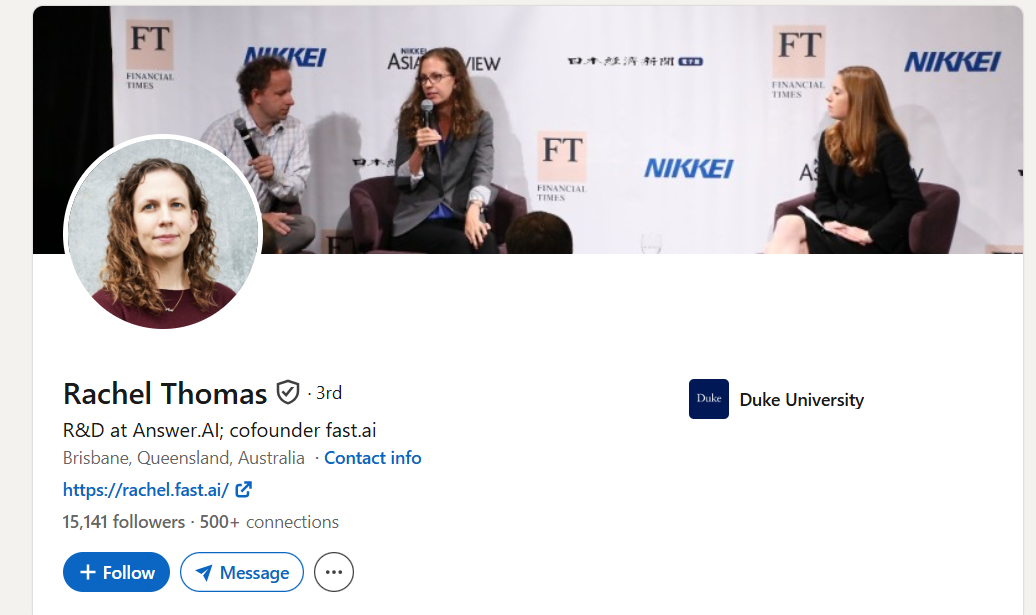
Dr. Rachel Thomas built her professional foundation in deep mathematical research, earning her PhD in Mathematics from Duke University as a James B. Duke Fellow. Her early career bridged advanced theory with industry application, working as an early software engineer at Uber and an industry data scientist. These experiences in corporate technical scaling provided the empirical insights that would later shape her public educational labs.
In 2016, she co-founded fast.ai alongside Jeremy Howard. Operating as a non-profit research lab, the initiative engineered the world's first university-accredited, open-access deep learning certificate, generating free software libraries built on top of Porch. Her open curriculum, including Practical Deep Learning for Coders, scaled globally to serve over 100,000 international students. This widespread democratic impact led to her selection by Forbes as one of twenty incredible women in artificial intelligence.
In July 2019, she established the Center for Applied Data Ethics at the University of San Francisco, directing public policy research, tech policy workshops, and algorithmic audits, including a critical analysis of California's vaccine allocation algorithms. Following a relocation to Australia, she served as a Professor of Practice at the Queensland University of Technology (QUT) and a strategy board member for the ARC Training Centre for Information Resilience. Her commercial and academic work expanded further when she completed a Master of Science in Microbiology and Immunology from Colorado State University to merge data fluency with life sciences, subsequently joining the R&D team at Answer.AI in late 2025.
Content Strategy & Teaching Approach
Thomas structures her communication strategy around challenging prevailing technical illusions, consistently applying Goodhart's Law to warn that when a metric becomes a target, it ceases to be a reliable measure. Writing through her independent platform, her essays frequently land on the front page of Hacker News by exposing how automated grading systems, algorithmic learning dashboards, and superficial corporate testing regimes frequently degrade human creativity.
Her instructional approach rejects traditional abstract pedagogy in favor of a code-first, top-down execution method. By encouraging students to build complex models immediately before dissecting the underlying mathematics, her teaching builds real-world engineering confidence while cultivating critical skepticism toward software limitations.
Posts on LinkedIn
Metrics & Impact
More than 15,000 followers on LinkedIn with an active interdisciplinary scientific network
Co-created deep learning courses utilized by over 100,000 software developers worldwide
Penned technical and ethical essays that reached the front page of Hacker News over 10 times
Pioneered global public tech policy education by founding the USF Center for Applied Data Ethics
Maintained perfect academic standards, earning a 4.00 GPA during specialized immunobiology graduate training
Media Appearance
Why She Matters?
Dr. Rachel Thomas provides an essential voice of reason within a highly commercialized technology field by proving that technical sophistication must be matched by ethical verification. Her transition into combining machine learning with molecular immunology targets the dangerous gap where computational models outrun actual biological realities. By providing elite technical education completely free to the public, she breaks down corporate monopolies to ensure that the future of automation remains open, critical, and accessible to all.
Profile Summary
Followers: 15,142 on LinkedIn
Startup: fast.ai
Mission: To democratize deep learning education and advocate for algorithmic accountability across technology and life sciences
Recognition: Selected as one of Forbes' 20 Incredible Women in AI, James B. Duke Fellow
Background: Former Uber engineer, Founding Director of the Center for Applied Data Ethics, Mathematics PhD from Duke University