Why Does LinkedIn Reward Engagement Bait More Than Real Expertise?
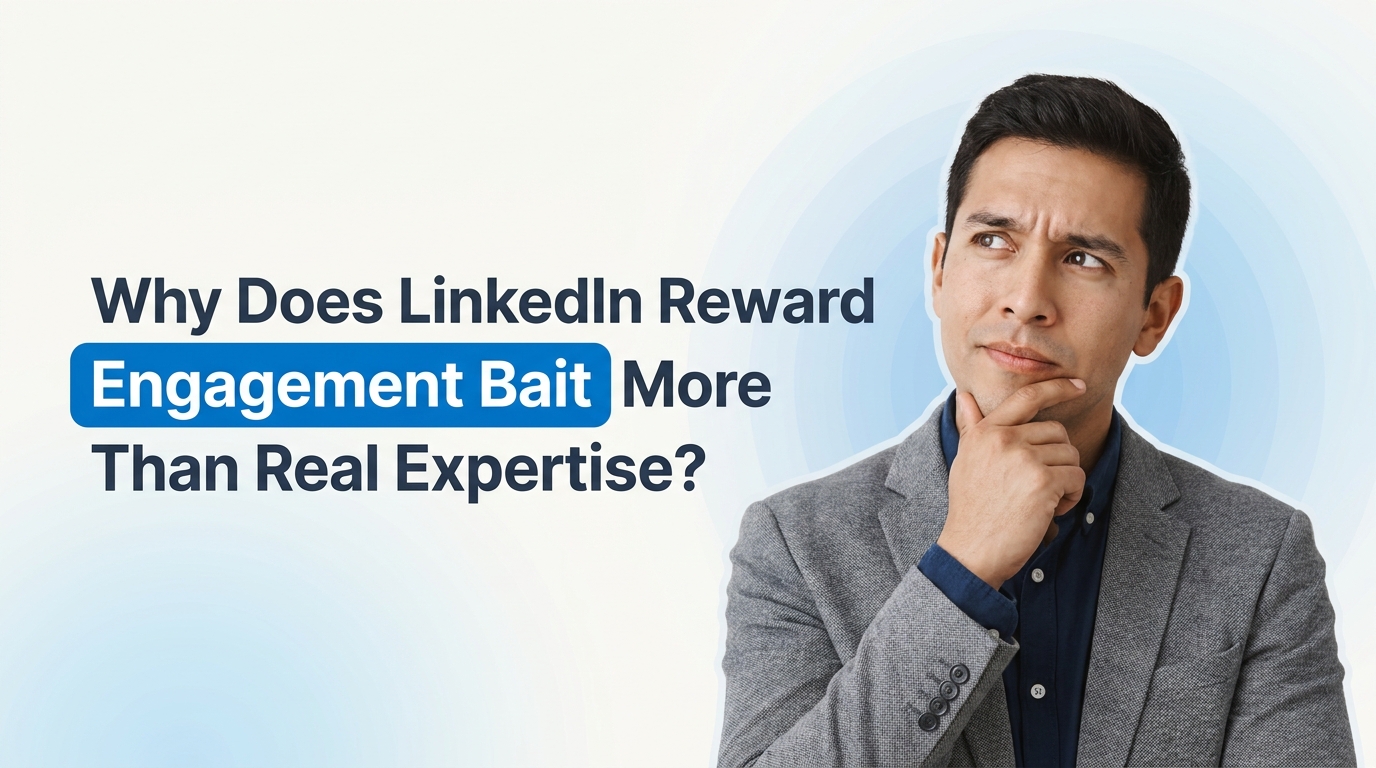
If you have ever opened LinkedIn and thought, "Why is this post getting thousands of reactions while genuinely useful insight gets ignored?" you are definitely not the only one. A lot of professionals feel this way. You spend years building real expertise, learning your craft, solving difficult problems, and then you watch a vague motivational post or a dramatic career story outperform thoughtful industry knowledge.
It can feel unfair. And honestly, sometimes it is. But there is a reason this keeps happening, and it is not always because expertise has no value. Usually, it is because platform behavior and audience behavior are not the same thing as professional value.
So let’s break it down in a simple way.
What do people mean by “engagement bait” on LinkedIn?
Engagement bait is content designed mainly to trigger reactions, comments, shares, or quick emotional responses rather than to teach something meaningful. On LinkedIn, that can look like:
Generic leadership advice with no real context
Overly polished personal stories that feel written for applause
Fake vulnerability posts that end with a predictable lesson
AI-generated “thought leadership” that sounds smart but says very little
Posts that ask people to comment with one word or simple opinions just to boost reach
None of this means every popular post is bad. Sometimes simple content connects because it is easy to understand and relatable. But the frustration starts when surface-level content gets rewarded faster than depth.
Why does LinkedIn seem to favor it?
There are a few practical reasons.
1. The algorithm rewards signals, not always substance
LinkedIn’s feed is influenced by how people respond to content. If a post gets early likes, comments, dwell time, and shares, the platform reads that as a signal that the post is worth showing to more people. The algorithm does not perfectly understand whether the advice is deep, original, or actually helpful. It mostly sees behavior.
That means a post that sparks emotion quickly can outperform a highly informed post that takes more effort to read.
If you want a general overview of how LinkedIn describes content distribution, their official resources are a useful starting point: LinkedIn algorithm overview.
2. Easy-to-consume content spreads faster
A complicated insight from someone with real expertise often needs context. It may require the reader to understand the industry, the problem, and the tradeoffs. That takes time.
But a post saying, “I stopped caring what people think and closed more deals” is simple. You can process it in seconds. Social platforms generally reward what is easy to consume, especially on mobile.
This does not mean people prefer lower quality in every case. It means frictionless content often wins the first round.
3. Emotion beats precision in public feeds
Content that triggers identity, ambition, fear, or validation tends to get quick responses. People react to things that make them feel seen, inspired, annoyed, or included. Expertise is often quieter. It may be more useful, but it is not always more emotionally activating.
That is why posts built around struggle, success, mistakes, confidence, burnout, and leadership cliches often travel well. They feel personal and accessible, even when they are repetitive.
4. Many real experts are not natural content creators
This part matters a lot. Some of the most knowledgeable professionals are busy doing the actual work. They may not have the time, interest, or skill to package their knowledge into posts that work well online.
So the issue is not always that expertise loses. Sometimes expertise is simply under-presented.
A good question to ask is: Are experts being ignored, or are they not communicating in a way the platform can distribute well?
Does this mean LinkedIn is bad for serious professionals?
Not really. It just means you need to understand the environment.
LinkedIn is not a peer-reviewed journal. It is a professional social network. That means attention often goes first to content that is:
Clear
Relatable
Emotionally resonant
Easy to respond to
Formatted for quick reading
The good news is that expertise and engagement do not have to be opposites. Strong professionals can still win on LinkedIn, but they usually need to translate their knowledge into content people can actually absorb.
So how can real experts compete without becoming cringe?
This is the part most people care about. If you do not want to post empty motivational content, what should you do instead?
1. Make your expertise more specific
Generic expertise performs poorly too. Instead of posting broad advice, narrow it down.
What problem are you solving?
Who is it for?
What mistake do people usually make?
What changed in your thinking after real experience?
For example, instead of saying, “Leadership is about trust,” say, “One thing I learned managing a remote team of 12 is that delayed feedback creates mistrust faster than disagreement does.”
That feels real because it is grounded.
2. Teach in plain language
A lot of experts accidentally hide good ideas inside jargon. LinkedIn readers are scrolling fast. Clear writing usually beats impressive writing.
Try this format:
State the problem
Explain why it happens
Share one example
Offer a practical takeaway
That structure makes real knowledge easier to engage with.
3. Use story as a delivery method, not a gimmick
Stories are not the problem. Fake stories are the problem. Real professionals can use story well when it supports a useful point.
Ask yourself:
Did this actually happen?
What did I learn from it?
Can someone else apply this lesson?
If the answer is yes, story can make expertise more human.
4. Write for conversation, not applause
One reason bait works is that it invites easy commenting. But you can do that without lowering quality. End posts with thoughtful questions like:
Have you seen this in your industry too?
What would you add from your experience?
What is one sign this approach is not working anymore?
Those questions invite actual discussion instead of empty validation.
5. Build credibility over time
Expert-led content often compounds slowly. A flashy post may spike. A useful body of work builds trust. The people who matter most to your career or business are usually not judging you by one viral post. They are watching for consistency, clarity, and relevance.
This is one reason content strategy matters more than one-off posting.
What kind of LinkedIn content actually balances depth and reach?
If you want practical formats, here are a few that tend to work well:
Myth vs reality posts: clear, educational, easy to scan
Short case studies: show what happened, what changed, and why
Industry breakdowns: explain trends in plain language
Lessons from mistakes: honest, useful, and memorable
Framework posts: simple steps readers can apply
If you want examples of strong professional content strategy, HubSpot has helpful guidance on creating content that is useful without becoming generic: HubSpot’s LinkedIn marketing guide.
And if you prefer video, this kind of breakdown can also help you think about platform behavior and audience psychology: YouTube videos on LinkedIn content strategy.
Why does it still feel like being good at LinkedIn matters more than being good at your job?
Because visibility and skill are different things, and social media compresses them into the same space.
Someone can be excellent at self-presentation and average at execution. Someone else can be brilliant at their profession and almost invisible online. LinkedIn often rewards the first person faster. But faster is not always better in the long run.
Real opportunities still come from trust, reputation, referrals, proof, and results. LinkedIn can amplify those things, but it cannot fully replace them.
That said, ignoring LinkedIn completely is not always the answer either. If your audience, buyers, peers, or future employers are there, then learning how to communicate your expertise on the platform is part of modern professional visibility.
A better way to think about LinkedIn
Maybe the healthier framing is this: LinkedIn does not always reward the smartest person. It often rewards the clearest, most relatable, and most consistent communicator.
That can be annoying, but it is also useful to know. Because once you accept that reality, you can stop trying to “win” the feed with empty hooks and instead focus on making your actual knowledge more accessible.
You do not need to become loud. You do not need fake vulnerability. You do not need to act like a motivational speaker if that is not you.
You just need to package expertise in a way that people can notice, understand, and respond to.
Final thoughts
If LinkedIn feels like it rewards engagement bait more than expertise, your frustration makes sense. The platform often prioritizes attention signals, and those signals are easier to trigger with emotion, simplicity, and repetition than with depth. But that does not mean expertise has lost. It means expertise needs better communication.
For professionals and brands trying to grow without sounding forced, this is where strategy becomes really important. A good LinkedIn presence is not about choosing between credibility and visibility. It is about connecting the two.
Write better LinkedIn content with EXEED AI
EXEED AI is an AI tool that helps you ideate, draft, and schedule content for your LinkedIn. Turn raw ideas into polished posts and stay consistent without the guesswork. Try EXEED AI.