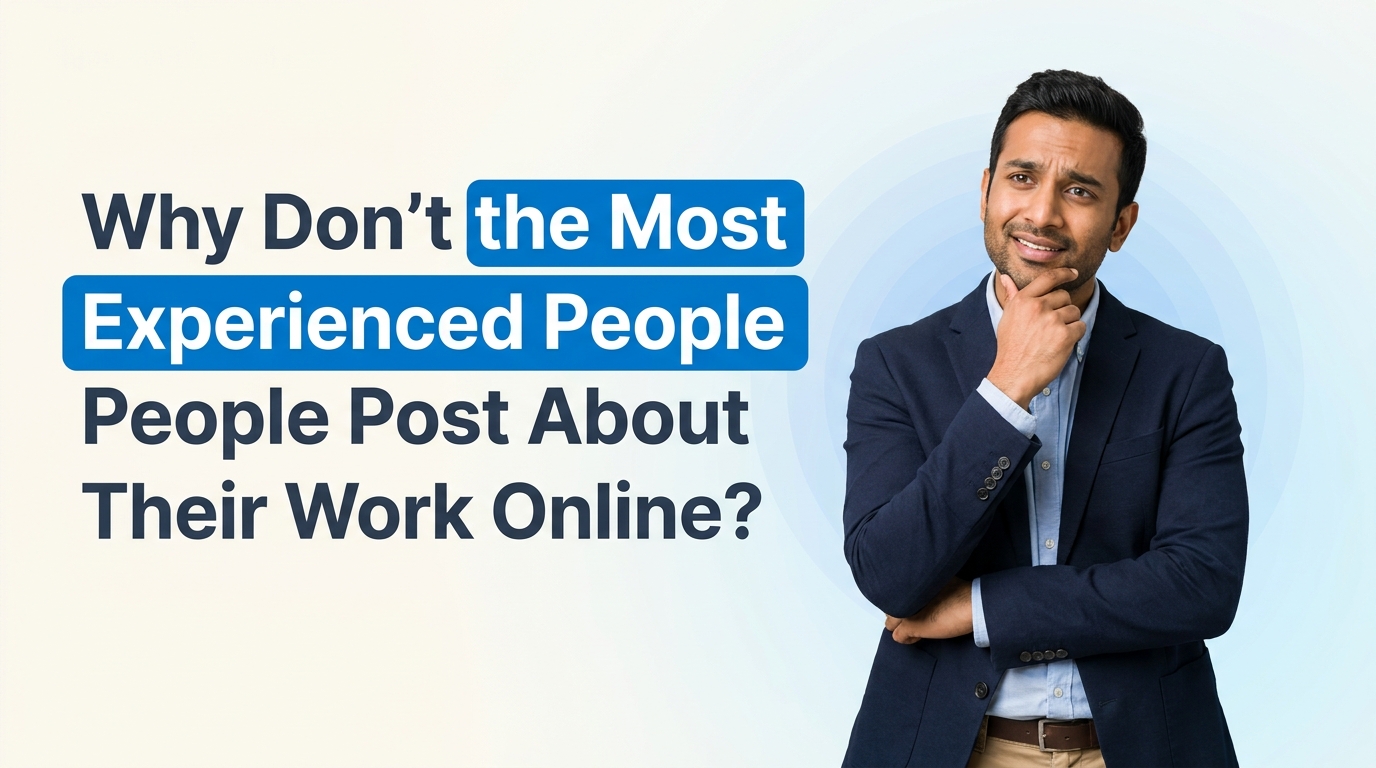
Why Don’t the Most Experienced People Post About Their Work Online?
Often their work is confidential, and complex work is hard to explain in a short post. See the other small frictions that keep thoughtful experts quiet.
It’s a fair question, and honestly, a really observant one.
A lot of people notice the same pattern: the more someone seems to have actually built, led, fixed, or survived in their career, the less likely they are to post constantly about it. Meanwhile, the people posting every day can sometimes seem a lot more visible than credible.
So what explains that gap?
If someone could write about their work but chooses not to, it usually is not because they have nothing to say. In many cases, it is the opposite. They have so much context, nuance, responsibility, and lived experience that posting feels complicated.
Let’s break that down in a way that feels practical and human.
Is it really true that the most capable people post less?
Sometimes yes, but not always.
There are plenty of highly experienced people who share thoughtful ideas online. But the general feeling behind this Reddit post makes sense because real expertise often comes with restraint. People who have done serious work usually know:
- how messy success really is
- how hard it is to explain complex work in a short post
- how public visibility can distort what actually matters
- how easy it is for people online to misread, oversimplify, or weaponize what you say
That doesn’t make posters less valuable or non-posters more valuable by default. It just means there are real reasons some thoughtful people stay quiet.
Why do experienced people avoid posting?
There usually isn’t one single block. It is more like a stack of small frictions.
1. Their work is confidential
This is one of the biggest reasons and probably one of the least discussed.
If someone works in leadership, consulting, healthcare, finance, product, legal, operations, or high-level strategy, a lot of what makes them useful cannot be shared publicly. The details are sensitive. The lessons are tied to people, clients, internal politics, failures, and decisions that are not theirs alone to publish.
So even if they have strong insight, they may ask themselves:
- Can I say this without exposing a client?
- Can I explain this without sounding vague?
- Can I make this useful without breaking trust?
That tension often leads to silence.
For a helpful perspective on professional trust and confidentiality, Harvard Business Review often covers this balance well: https://hbr.org.
2. They do not want to perform expertise
A lot of accomplished people are tired of the pressure to turn every lesson into content.
Posting online can sometimes feel less like sharing and more like performing. You are not just saying what you know. You are packaging it. Framing it. Simplifying it. Making it catchy. Hoping it lands.
And for people who value substance, that can feel off.
They may think, “If I have to flatten this into a punchy paragraph to get attention, maybe I would rather not post it at all.”
3. They are still processing what they know
Real experience is not always instantly writable.
Sometimes people need distance before they can explain what happened, what mattered, and what they actually learned. If they are still in the middle of hard work, they may not have a neat conclusion yet.
And that is normal.
Not every smart person is ready to publish in real time. Some people need months or years before they can turn experience into useful insight.
4. They have seen how the internet reacts
This one matters more than people admit.
Posting publicly can invite:
- bad-faith comments
- oversimplified arguments
- people projecting motives onto you
- content theft
- pressure to keep posting once one post does well
For someone with a demanding career, that tradeoff can feel pointless. If the reward is a little visibility and the risk is misunderstanding or noise, staying quiet can seem rational.
Pew Research has useful data on online behavior and public participation: https://www.pewresearch.org/internet/.
5. They are busy doing the actual work
This sounds obvious, but it is still true.
Many experienced professionals are managing teams, shipping projects, solving problems, handling clients, or just protecting their energy. Writing thoughtful posts takes time. Good posting is not quick if you care about quality.
So a lot of capable people make a simple decision: they would rather invest that time in the work itself.
6. They do not think their knowledge is unique
Funny enough, the more competent someone is, the more likely they may assume what they know is basic.
This is close to the “curse of knowledge.” What feels obvious to them may actually be deeply useful to others. But because it feels normal inside their own world, they do not think it is worth posting.
That means some of the people with the most practical insight are also the least likely to share it.
If you want a solid explainer on the curse of knowledge, this short video is useful: https://www.youtube.com/watch?v=QwF9a56WFWA.
Get 10 hooks for your next post
Type what your post is about and get 10 opening lines from different proven angles. Free, no signup.
Or open the free LinkedIn hook generator
So is not posting a sign of credibility?
Not automatically.
It is tempting to romanticize quiet people and distrust visible people, but that is too simple. Some people are brilliant and never post. Some are brilliant and post often. Some people are great at marketing weak ideas. Others are great at explaining hard-won insight clearly.
The better question is probably this:
When someone posts, are they helping you think better, ask better questions, or do better work?
That matters more than posting frequency alone.
What blocks thoughtful people from posting on LinkedIn specifically?
LinkedIn adds its own layer to this.
Unlike anonymous forums, LinkedIn ties your thoughts to your name, employer, network, peers, clients, and future opportunities. That changes the emotional stakes.
Someone might hold back because they are wondering:
- Will my employer read this the wrong way?
- Will this sound self-promotional?
- Will clients think I am revealing too much?
- What if people from my industry think this is obvious or naive?
- Do I really want colleagues judging my tone?
That is a very different environment from casually posting on a forum. LinkedIn can be valuable, but it also makes people more cautious.
LinkedIn itself shares best practices for professional content here: https://www.linkedin.com/business/marketing/blog.
If someone wants to post but feels blocked, what actually helps?
This is where the conversation gets useful.
If the issue is not lack of ideas but friction, the goal is to lower the pressure.
Try these simpler ways to share:
- Write about patterns, not secrets. You do not need to expose names or details to share what you have noticed.
- Teach one small lesson. Not every post needs to be a grand opinion piece.
- Use “here’s what I’ve learned” instead of “here’s the truth.” That feels more honest and less performative.
- Share process, not polish. People often connect more with thoughtful reflection than perfect authority.
- Start with questions. Questions can be safer than declarations and often create better conversations.
For example, instead of saying, “Here is how to lead a high-stakes client transformation,” someone could say, “One thing I’ve learned from complex client work: the hardest part usually is not strategy, it is alignment.”
That still shares insight without exposing anyone.
What kind of content do people actually want from experienced professionals?
Usually, not polished bragging.
People tend to respond better to content that feels grounded, such as:
- mistakes that changed how you work
- tradeoffs people do not talk about enough
- what looks easy from the outside but is not
- how decisions are really made behind the scenes
- lessons from managing risk, people, time, or expectations
That kind of content feels believable because it carries texture.
And honestly, that is why the original Reddit question hits something real. A lot of readers are hungry for substance. They are tired of generic advice and want something that sounds like it came from a person who has actually been in the room.
Final thought
If someone experienced is not posting, the block is usually not laziness, lack of ideas, or lack of generosity. More often, it is caution, complexity, time, professional risk, or discomfort with turning real work into public content.
That does not mean they should stay silent forever. It just means the barrier is understandable.
And if you are one of those people who has done meaningful work but struggles to share it, maybe the better goal is not “post more.” Maybe it is “share in a way that still feels true to how you work.” That is a much better starting point.
At EXEED Digitals, we see this all the time with founders, executives, consultants, and subject-matter experts on LinkedIn. They are not short on ideas. They are usually short on time, clarity, or a format that feels natural. That is exactly where support helps. Our team at EXEED Digitals usually helps turn deep experience into thoughtful LinkedIn content without making people sound forced or overly polished. It is one reason our LinkedIn agency has helped 100s of brands show up better, build trust, and communicate real expertise more clearly on LinkedIn.
en