Best Time to Post on LinkedIn in 2026: By Day, Industry and GCC
Post Tuesday to Thursday between 11 AM and 5 PM local time. See 2026 Sprout, Buffer and Hootsuite data by day and industry, UAE and Saudi timing and a 2-week test plan.
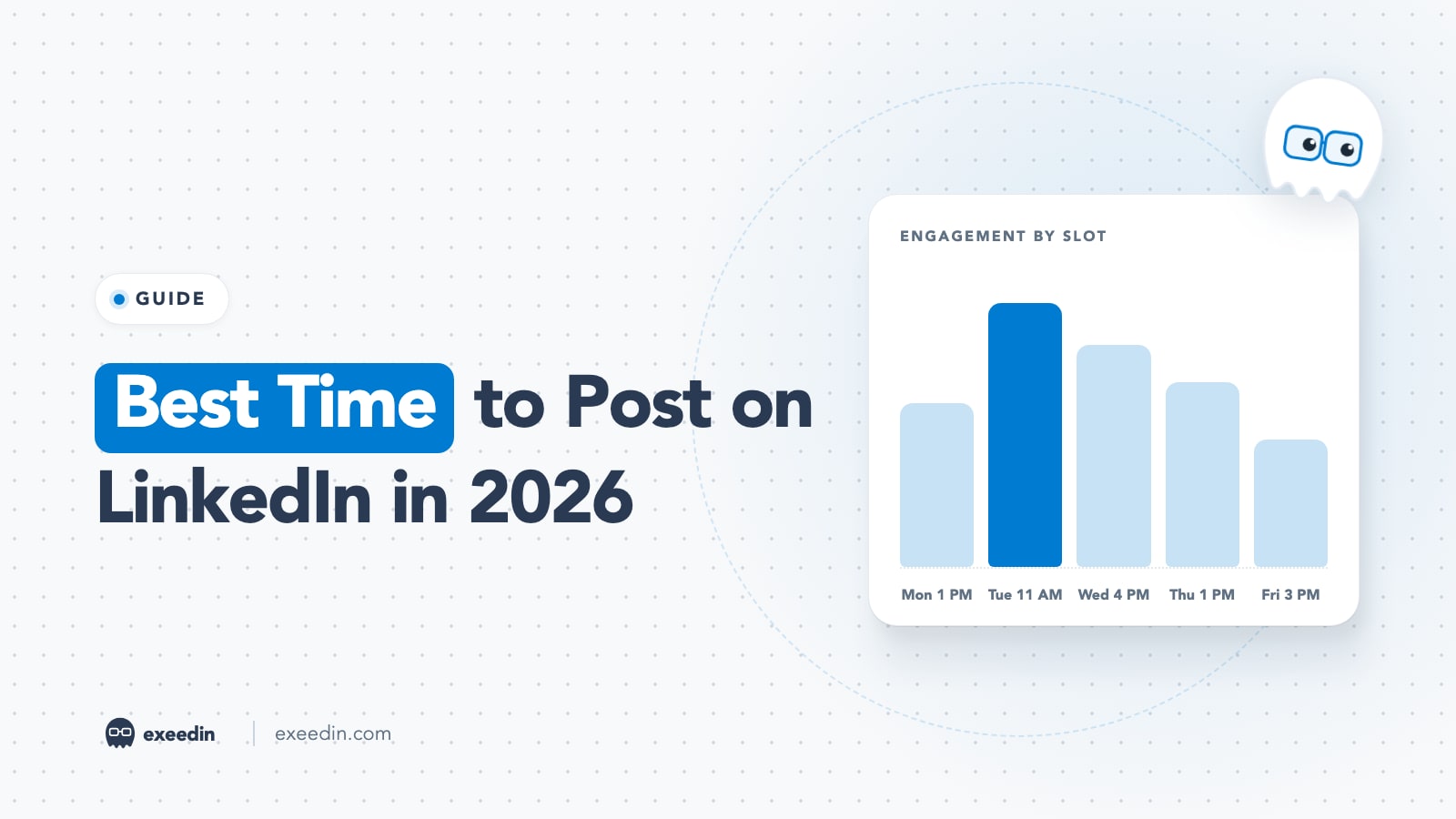
The best time to post on LinkedIn in 2026 is a weekday, Tuesday to Thursday, between about 11 AM and 5 PM in your audience's local time. Sprout Social's March 2026 data favors late morning to mid-afternoon, while Buffer's September 2026 analysis found engagement peaking later, from 3 PM to 8 PM, with Wednesday at 4 PM the top slot. Weekends are weakest.
Below we compare the current versions of the three biggest timing studies, each with its date and sample size, then break results down by day and industry. You will also find a section for audiences in the UAE and Saudi Arabia, where the work week differs, an honest look at the "golden hour" claim, and a two-week test plan to find your own best time.
Best time to post on LinkedIn: the short answer
- Best days: Tuesday, Wednesday and Thursday. All three studies rank midweek highly.
- Safe window: 11 AM to 5 PM local time on weekdays, where Sprout's and Buffer's peaks overlap.
- Worst days: Saturday and Sunday in the US and Europe. In Saudi Arabia, Friday and Saturday are the weekend.
- Best overall advice: use these windows as a starting point, then test against your own analytics.
What the 2026 studies say
| Study | Published | Sample | Best days | Peak window |
|---|---|---|---|---|
| Sprout Social | March 31, 2026 | About 2 billion engagements across 307,000 profiles (Nov 2025 to Feb 2026), all networks | Tue, Wed, Thu | 11 AM to 5 PM |
| Buffer | September 9, 2026 | 4.8 million posts sent through Buffer | Wed, then Thu and Fri | 3 PM to 8 PM |
| Hootsuite | November 19, 2025 | 1 million+ posts, Q4 2024 data, 118 countries | Tue, Wed | 8 AM to 9 AM (key takeaway) |
All three normalize results to the audience's local time, so "4 PM" means 4 PM wherever your followers are, not in a single time zone.
The studies disagree on hours, which is useful in itself. Sprout's peak sits in the working day. Buffer found that peak engagement moved later than in its 2025 data, which had been almost entirely confined to working hours, and that morning posts from 6 AM to 11 AM now tend to see lower engagement. Hootsuite, using older Q4 2024 data, still points to early mornings. If the three biggest studies cannot agree, your own audience is likely to differ from all of them.
Get 10 hooks for your next post
Type what your post is about and get 10 opening lines from different proven angles. Free, no signup.
Or open the free LinkedIn hook generator
Best time to post on LinkedIn by day
| Day | Sprout Social (2026) | Buffer (2026) | Hootsuite (2025) |
|---|---|---|---|
| Monday | 1 PM to 2 PM | 10 PM, 5 PM, 9 PM | 11 AM |
| Tuesday | 11 AM to 5 PM | 4 PM, 5 PM, 10 PM | 6 AM to 8 AM |
| Wednesday | 11 AM to 4 PM | 4 PM, 3 PM, 5 PM | 9 AM |
| Thursday | 11 AM and 1 PM to 5 PM | 5 PM, 7 PM, 9 PM | 2 PM |
| Friday | 11 AM and 1 PM to 2 PM | 3 PM, 4 PM, 5 PM | 8 PM |
| Saturday | Avoid | 9 AM, 6 PM, 10 PM | 4 AM to 5 AM |
| Sunday | Avoid | 10 PM, 9 PM, 6 AM | 6 AM |
Buffer lists its top three hours per day in order of performance. Note that Buffer found Monday and Tuesday had the lowest engagement in its data, while Sprout ranks Tuesday among the strongest days. That kind of conflict is normal: each tool's customers have different audiences.
Best time to post on LinkedIn by industry
Sprout Social and Hootsuite both publish industry cuts. Sprout's are more detailed and more recent, so they lead this table.
| Industry | Sprout Social (2026) | Hootsuite (2025) |
|---|---|---|
| Technology and software | Mon 12 to 1 PM; Tue 10 AM to 2 PM; Wed 10 AM to 4 PM; Thu 10 AM to 3 PM; Fri 11 AM to 1 PM, 3 PM | Mon 11 AM |
| Financial services | Mon 10 AM, 12 to 1 PM; Tue 10 AM to 3 PM; Wed 8 AM, 10 AM to 3 PM; Thu 8 AM to 2 PM; Fri 11 AM | Mon 5 PM; Wed 1 PM; Thu 5 to 7 PM; Fri 11 AM to 1 PM |
| Healthcare | Mon 1 to 2 PM; Tue 10 AM to 2 PM, 4 PM; Wed 11 AM to 5 PM; Thu 9 AM to 4 PM; Fri 1 PM | 9 AM to 1 PM, Tue to Fri |
| Education | Mon 2 PM, 4 PM; Tue 10 AM to 5 PM; Wed 11 AM to 4 PM; Thu 10 AM to 4 PM; Fri 12 PM | Wed 9 AM; Fri 11 AM to 1 PM |
| Government | Mon 1 PM, 3 PM; Tue 10 AM to 1 PM, 3 to 5 PM; Wed 11 AM to 12 PM, 2 to 5 PM; Thu 10 AM to 5 PM; Fri 3 PM | Mon 3 PM; Tue 9 to 11 AM; Wed 10 AM; Sat 11 AM to 1 PM |
| Nonprofit | Mon to Thu 10 AM to 2 PM (Wed to 4 PM); Fri 10 to 11 AM | Tue 11 AM to 2 PM; Wed 12 to 3 PM; Sat 11 AM |
| Retail | Mon 12 PM; Tue 10 AM to 12 PM, 3 PM; Wed 10 AM to 2 PM; Thu 8 AM to 3 PM; Fri 9 AM to 12 PM, 2 to 3 PM | Not reported |
| Travel and hospitality | Mon 11 AM to 12 PM; Tue 10 AM to 2 PM; Wed 10 AM to 4 PM; Thu 10 AM to 3 PM; Fri 11 AM, 1 to 3 PM | Wed 12 PM |
| Real estate, legal, professional services | Not reported | Thu 8 to 10 AM; Sat 10 AM to 1 PM |
Across every industry in Sprout's data, weekdays were best and weekends worst.
Best time to post on LinkedIn in the UAE and Saudi Arabia
The global studies assume a Monday to Friday week. Two of the largest LinkedIn markets in the Gulf do not follow the same calendar, so adjust before you copy any US schedule.
United Arab Emirates
- Since 1 January 2022, the federal government works a four and a half day week: Monday to Thursday 7:30 AM to 3:30 PM and Friday 7:30 AM to 12 PM, with Saturday and Sunday as the weekend, according to the official UAE government portal. Abu Dhabi, Dubai, Ajman, Umm Al Quwain, Ras Al Khaimah and Fujairah follow a similar system. Sharjah's government works Monday to Thursday with a Friday to Sunday weekend.
- The private sector varies. The UAE fact sheet notes most private companies close only on Sunday, while some close on both Saturday and Sunday.
- The UAE is 4 hours ahead of GMT, per the same fact sheet.
What that means for posting: treat Monday to Thursday as the core window. Friday afternoon is quiet for government and many corporate audiences, and Saturday is a working day for parts of the private sector. Late morning and the early afternoon, before offices close around 3:30 PM, are sensible starting slots to test.
Saudi Arabia
- The Saudi weekend is Friday and Saturday, after a royal decision moved it from Thursday and Friday in 2013, as Saudipedia records. The working week runs Sunday to Thursday.
- Saudi Arabia uses UTC+3 all year with no daylight saving time, per this time zone reference.
What that means for posting: Sunday is a normal working day and worth testing, since many global accounts are silent then. Thursday afternoon and evening start the weekend, and Friday is the weakest day for professional content.
Posting to a mixed Gulf and global audience
- If most of your audience is in Riyadh and Dubai, Sunday to Thursday mornings in Gulf time catch both countries at work, except Sunday for most UAE offices.
- If you write in Arabic for Gulf readers and in English for a global audience, schedule the two posts separately, each in its audience's working hours. Our guides on content that resonates with GCC audiences and personal branding for GCC success cover the content side.
Working hours change during Ramadan in both countries, so check your analytics during that month rather than assuming the usual pattern holds.
Time zones: post for your audience, not for you
Every study above uses the audience's local time. If you live in Dubai and sell to clients in London, your best time is London's best time. Check where your followers are in your LinkedIn analytics (the audience demographics show locations), then schedule for the largest group.
LinkedIn's native scheduler uses your device's clock: LinkedIn's scheduling help page says scheduled times are converted to UTC based on your device's time zone settings. So when you schedule for another region, convert the time first. Scheduling tools such as exeedin suggest posting slots, but you still decide which audience's clock matters. For step-by-step instructions, see our guide on how to schedule a post on LinkedIn.
The first hour after posting: what the data really says
You will often read that the first 60 to 90 minutes decide a post's fate. LinkedIn has never published an official window, so be careful with confident claims. What the data does show:
- Early engagement correlates with reach. Ordinal's analysis of 290,032 LinkedIn posts found posts that got their first like or comment within 5 minutes averaged 17,692 impressions, versus 11,426 when the first engagement came after 15 to 60 minutes and 6,422 after 60+ minutes. That is a correlation from a vendor's dataset: stronger posts get engaged with faster, so it does not prove timing alone causes reach.
- Posts keep collecting views for days. Metricool's 2026 LinkedIn study found 50% of total impressions happen within the first 48 hours, which means a post's life is much longer than one hour.
The practical lesson is simple. Post when you can stay around for the next hour to reply to comments, and when your most engaged connections are online. A perfect time slot with no replies from you loses to a decent slot where you answer every comment. Thoughtful replies also count; see our guide to writing comments that feel human.
Why your own data beats any average
Benchmarks are averages over hundreds of thousands of accounts with very different audiences. Your followers are a tiny, specific slice of LinkedIn, and several things can pull your best time far from the averages:
- Audience geography. A US-based study's "Tuesday at 11 AM" says nothing about a Riyadh audience working Sunday to Thursday.
- Job roles. Executives, nurses, engineers and students check LinkedIn at different moments. The industry tables above show how much that moves the window.
- Your own habits. Followers who engage with you every week learn when you post. Consistency can matter as much as the slot itself.
- Competition and metrics. Busy hours also carry the most posts, and studies count "best" differently (engagement rate vs raw engagement).
- Old data. Hootsuite's 2025 article uses Q4 2024 data, while Buffer reports engagement shifting later in 2026. Habits change year to year.
Even Hootsuite's own article notes its LinkedIn team gets better results on Mondays and Fridays than its overall data suggests. That is the strongest argument for testing.
A two-week test plan to find your best time
Two weeks will not give statistical certainty, but it can show a clear winner or loser. Keep topic and format similar so time is the main variable.
- Pick three windows to compare. For example: late morning (10 to 11 AM), early afternoon (1 to 2 PM) and late afternoon (4 to 5 PM), all in your main audience's time zone. Gulf audiences should include a Sunday slot.
- Plan six posts. Post three times a week for two weeks, so each window gets two posts. Rotate windows across different days so one weekday does not skew the result.
- Keep everything else steady. Same format family (for example, all image or all text posts), similar length, similar topic depth.
- Be present for the first hour. Reply to every comment in the same way for every test post, or the test measures your replies rather than the slot.
- Record results after 48 hours and after 7 days. Track impressions, comments, reactions and profile views for each post in a simple sheet.
- Compare windows, not posts. Average the two posts in each window. A window that wins on both posts is a real signal; a single viral post is not.
- Lock in the winner, then retest monthly. Make the winning window your default, and keep one post a month in a new slot to check that your audience has not shifted.
Here is a simple schedule you can copy:
| Post | Week | Day | Window |
|---|---|---|---|
| 1 | 1 | Tuesday | 10 to 11 AM |
| 2 | 1 | Wednesday | 1 to 2 PM |
| 3 | 1 | Thursday | 4 to 5 PM |
| 4 | 2 | Tuesday | 4 to 5 PM |
| 5 | 2 | Wednesday | 10 to 11 AM |
| 6 | 2 | Thursday | 1 to 2 PM |
For a Saudi audience, swap Tuesday for Sunday. To read results, use LinkedIn's built-in post analytics. And if you are deciding how many posts a week to commit to, see how often you should really post on LinkedIn.
Timing tips that matter more than the clock
- Avoid the top of the hour. Hootsuite suggests posting a few minutes off the hour, since many brands schedule for exactly :00.
- Schedule ahead, then show up. Scheduling keeps you consistent, but block 30 to 60 minutes after each post to reply. Our take on whether to schedule LinkedIn posts ahead covers the trade-offs.
- Match the format to the moment. A long document carousel suits a calm mid-morning; a quick opinion post fits a lunch scroll. See LinkedIn post formats compared.
- Do not post twice in a few hours. Give each post room to collect its first day of engagement.
Frequently Asked Questions
What is the best day to post on LinkedIn?
Midweek. Sprout Social's March 2026 study names Tuesday, Wednesday and Thursday as the most consistent days, and Buffer's September 2026 analysis of 4.8 million posts ranks Wednesday first, followed by Thursday and Friday. Weekends are weakest in both. In Saudi Arabia, where the weekend is Friday and Saturday, Sunday is a working day worth testing.
Is it better to post on LinkedIn in the morning or afternoon?
Recent data leans toward late morning and afternoon. Sprout Social's 2026 peak runs roughly 11 AM to 5 PM on weekdays, and Buffer's 2026 data found morning posts from 6 to 11 AM tend to see lower engagement than afternoon and evening slots. Hootsuite's older data favors early mornings, so test both windows with your own audience.
What is the best time to post on LinkedIn in the UAE?
Start with Monday to Thursday in late morning or early afternoon UAE time (GMT+4). Since 2022 the federal government works Monday to Thursday plus a Friday half day, with a Saturday and Sunday weekend, though many private companies close only on Sunday. Friday afternoon is usually quiet. Run a two-week test to confirm what works for your followers.
What is the best time to post on LinkedIn in Saudi Arabia?
Post during the Sunday to Thursday working week, in Saudi time (UTC+3, no daylight saving). Late morning and early afternoon are sensible starting slots, and Sunday is worth testing because many global accounts are quiet then. Avoid Friday and Saturday, the weekend days.
Does posting time really matter on LinkedIn?
It matters, but less than the post itself. Timing decides who is online to react first, and Ordinal's data on 290,032 posts shows faster first engagement correlates with more impressions. Yet Metricool found half of a post's impressions arrive over 48 hours, so a strong post keeps spreading. Choose a sensible slot, then focus on quality and replying to comments.